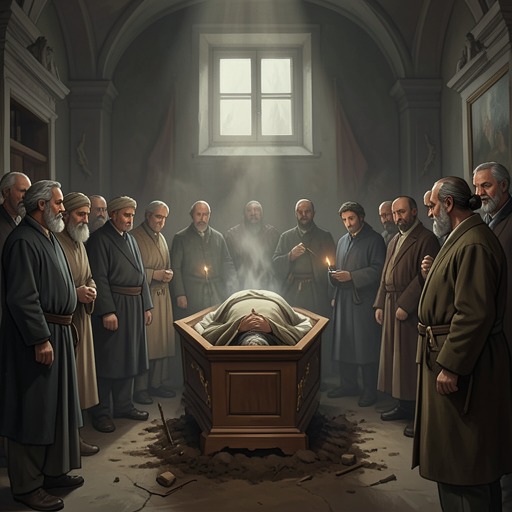
“we are all of dust and to dust must return”
Elena KnowsThe dust-return formula in Elena Knows connects the physical fate of the dead with disputes over faith, bodily ownership, and maternal grief. Repeated around Rita’s burial and in Elena’s later appeal to Isabel, it carries an uneasy double meaning: it recalls religious language about mortality while Elena, who does not believe in an afterlife, understands dust as the material remainder to which bodies return.
Burial and the Material Body
At Rita’s funeral, Elena chooses a cheap wooden casket not only because money is limited but because she wants Rita’s body to rot quickly. She sees no reason to delay the return to dust with expensive hardwood when both coffin and body are destined to decay. The thought is practical and unsentimental, but it also refuses the funeral’s potential display of status: a costly casket cannot preserve the person who once inhabited the body.
Elena’s reasoning becomes starkly physical. Rita’s body, she thinks, no longer holds the person Rita was; it is like an empty bag or a pod without seeds. The dust formula therefore does not promise Elena reunion with her daughter. Instead, it names the irreversible transformation she has chosen to hasten by selecting the casket. The funeral’s religious language and its material arrangements meet at the same point, but they do not mean the same thing to her.
A Saying Without Belief
Elena has long concealed from Antonio, her practising Catholic husband, that she does not believe in the soul or eternal life. His work at the Catholic school—as porter and theology teacher—made her disbelief something she expected him not to understand. Even after she can no longer maintain the concealment, religious words remain in her mind: heaven and hell, resurrection, the Creed, sin, penitence, and dust returning to dust. Their persistence does not establish faith. For Elena, the words endure as inherited language after belief has fallen away.
Rita’s practice of religion differs from both her parents’ positions. Elena remembers her as wearing a cross and observing many rituals, while also skipping Mass when it rained, sometimes withholding confession, and occasionally deciding that God did not deserve praise. Rita’s observance is selective but sustained: she visits seven churches on Good Friday, fasts during several religious observances, and follows particular rules around Mass and Communion. The dust formula thus belongs to a household where religious speech and practice are present, but conviction is neither uniform nor reducible to ritual.
Dust, Place, and the Limits of Consolation
During Elena’s taxi journey, the formula briefly seems to offer a religious account of what happens after death. She considers whether she could believe in a soul, eternal life, and the return to dust described in the Gospels. But the thought ends in the earthly dust on her shoes as she climbs into the taxi. The movement is characteristic of her reasoning: an abstract promise of transcendence gives way to the material conditions of travel, an aging body, and the ground beneath it.
The journey also joins the fates of mother and daughter without making them identical. Elena thinks of Rita buried underground and of the body that once grew inside her; both are mortal bodies, but only one has already returned to the earth. The phrase’s apparent universality—everyone returns to dust—cannot erase the particularity of Elena’s loss or answer what remains of a person when the body is gone.
The Formula as an Expression of Grief
When Elena visits Isabel, she invokes the dust formula while explaining the debt she believes Isabel owes Rita. Rita helped Isabel twenty years earlier, Elena says, and Isabel went on to build a family; Elena, by contrast, has no one left to hold. She admits that she did not hug Rita much while she was alive, and that she now cannot embrace her because Rita is dead and her body is in the ground. The old religious wording becomes inseparable from a specific regret: the lost possibility of touch.
In that conversation, the formula is not a resolution or a source of comfort. It gives Elena a way to speak of the body’s return to earth, but cannot restore the relationship or settle the debt she has come to call in. Its recurrence binds the funeral, Elena’s reflections on belief, the taxi ride, and her confrontation with Isabel; each return strips away another layer of abstraction until the saying bears the weight of one mother’s grief for one dead daughter.